
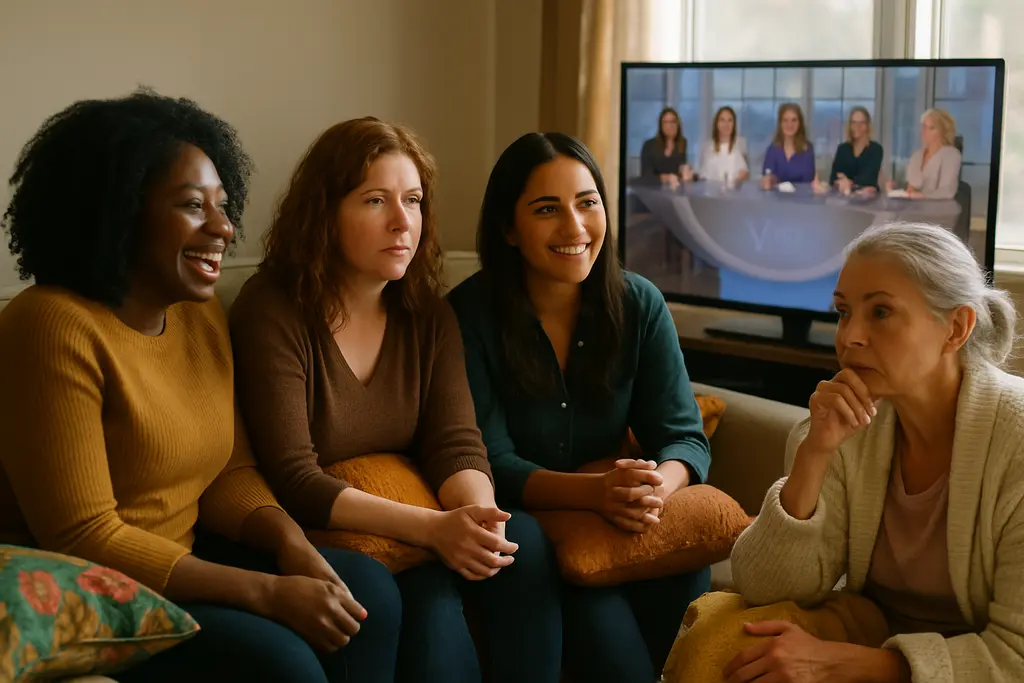

Confirmed: The View Ratings point to a clear mid-2026 story: ABC’s daytime panel show grew with women viewers at a time when many daytime formats still have to prove their relevance across broadcast habits, clips, social conversation, and full-episode viewing. The available data does not support an exaggerated comeback narrative, but it does show measurable movement in women 25-54 and women 18-49, two audience groups that remain central to daytime television’s advertising and cultural value.
The safer reading is not that one booking or one week changed everything. It is that The View had several data points in 2026 that lined up in the same direction. Those figures suggest steadier engagement among women viewers, especially during politically active news cycles and high-interest daytime conversations. For a long-running show in its 29th season, that kind of movement matters because longevity can often be mistaken for stasis.
What The View Ratings Say About Women Viewers
The View Ratings And The Women 25-54 Signal
Confirmed: For the week of June 15-19, 2026, The View averaged 2.942 million total viewers. In the same week, it drew 244,000 women 25-54 and 189,000 women 18-49, based on Nielsen Live+Same Day Big Data + Panel figures reported by Soap Opera Network. The report also described those numbers as double-digit growth compared with the same week one year earlier.
That week is useful because it shows more than total-viewer strength. Total viewers can be shaped by older daytime habits, household availability, or major news interest. The women 25-54 and women 18-49 figures point to a more commercially sensitive part of the audience. In broadcast daytime, growth among those viewers can say as much about relevance as raw reach does.
Market-analysis: The View Ratings in that June week suggest the show was not relying only on legacy viewing. It still had the ability to attract women in age bands that advertisers and programmers watch closely. That does not mean every episode performed at that level, but it gives analysts a concrete marker for how the show’s audience could expand when topic selection, guest interest, and daytime availability aligned.
Why Total Viewers Still Matter
Total viewership should not be dismissed just because demographic numbers get more industry attention. A daytime talk show with nearly 3 million viewers during a June week is still operating at a scale that many streaming talk formats do not match in a single release window. The broadcast model has limits, but it also has a daily rhythm that can build viewer habit across homes, workplaces, waiting rooms, and shared clips.
Opinion: That daily rhythm is part of the show’s cultural utility. The View is not only a celebrity-interview platform or a political discussion table. It functions as a daytime reaction space where women viewers can see public issues filtered through disagreement, identity, generational difference, and performance. Whether one likes the format or not, the audience pattern suggests that the show still occupies a recognizable place in daytime TV behavior.
The Demographic Shift Behind The Growth
Confirmed Quarterly Gains
Confirmed: In Q2 2026, covering April through June, The View averaged 2.6 million total viewers, up 3% year over year. Among women 25-54, it averaged 221,000 viewers, up 11% from Q2 2025. Among women 18-49, it averaged 168,000 viewers, up 14% from the prior year, according to TheWrap’s Q2 ratings report.
The quarterly numbers are more useful than a single-week spike because they smooth out some event-driven noise. A one-day guest appearance can lift a program. A quarter requires repeated audience behavior. The reported Q2 increases in both women demos suggest that the gains were not limited to a single episode or a brief publicity flare.
Market-analysis: This is where the women 25-54 result stands out. That group is often treated as a core daytime audience segment because it overlaps with consumer decision-making and household purchasing patterns. A double-digit year-over-year increase in that group gives ABC a stronger case that The View remains commercially useful, not just culturally visible.
Women 18-49 And Generational Reach
The women 18-49 increase is also significant, though it should be handled with care. Daytime broadcast television naturally faces more friction with younger viewers, who are more likely to encounter talk-show moments through clips, social feeds, podcasts, or news recaps rather than live viewing. Growth in women 18-49 therefore suggests either stronger appointment behavior, stronger topic interest, or better conversion from broader awareness into same-day viewing.
Opinion: The more interesting cultural signal is not that younger women suddenly returned to old broadcast habits wholesale. It is that a long-running daytime format still has ways to become relevant during moments of political tension, cultural debate, and media fragmentation. The show’s panel structure can generate disagreement quickly, which helps it travel beyond the original broadcast, even when the reported ratings measure live and same-day viewing.
Why The View Ratings Growth Looks Sustained
Season-To-Date Context
Confirmed: The same Q2 reporting said that, season to date as of mid-2026, The View was up 8% among women 25-54 and up 6% among women 18-49 versus comparable weeks in the prior season. It also reported that the show had its strongest performance in those demographics in three years and was the only daytime talk show to grow in both female demos.
That last point matters, but it should not be stretched beyond what the data says. It does not mean daytime talk as a category is suddenly expanding. It means The View, within the measured frame cited, improved where peer shows did not. That distinction is essential because the broader category still faces pressure from streaming, social video, and changing workday routines.
Market-analysis: The View Ratings growth looks more durable when weekly, quarterly, and season-to-date measures all point in the same direction. A cautious analyst would still ask what share of that growth came from particular news events, guest bookings, or political cycles. Yet consistency across several measurement windows makes it harder to treat the improvement as accidental.
Why The Format May Help
The View has one structural advantage: it is built to react. Scripted television often needs long production cycles. A daily talk show can respond to a major political exchange, entertainment controversy, court ruling, election development, or cultural flashpoint within hours. That speed gives it an edge with viewers who want interpretation as much as information.
Opinion: The panel format can also serve women viewers who do not see public debate as separate from everyday life. The show’s recurring mix of politics, celebrity, media, family, health, and identity mirrors the way cultural topics actually move through many households. That does not make every segment equally successful, but it explains why the format can remain useful long after many daytime competitors have faded.
Cultural Stakes For Daytime Talk

Audience Reaction Beyond A Single Platform
Ratings are only one measure of audience response. A daytime show also lives through clips, headlines, social debate, and secondhand discussion. The available figures cited here measure broadcast viewing, not the full afterlife of a segment online. That limitation should keep any analysis modest. Still, broadcast growth among women viewers is a meaningful base because it shows the original program has not been reduced only to viral fragments.
Market-analysis: For ABC, growth among women viewers gives The View more than bragging rights. It supports the show’s position as a daytime anchor, a news-adjacent discussion format, and a brand that can generate daily audience attention. For the wider television business, it is a reminder that linear TV is weaker than it once was, but not culturally empty.
There is also a network identity question. ABC benefits when The View can connect entertainment talk to news discussion without fully becoming a hard-news program. That middle position is commercially valuable because it can attract viewers who may not seek a straight political broadcast but still want public issues framed through personality and debate.
Why Caution Is Still Needed
The strongest risk in interpreting these numbers is over-crediting a single cause. The research notes mention high-profile episodes and political guests as likely accelerants, but the permitted data here is best read as a ratings trend rather than proof of one specific driver. Audience growth can come from scheduling, news intensity, guest interest, panel chemistry, promotional strength, or weaker competition.
For readers interested in the intersection of television ratings and cultural dynamics, insights from related sites such as Biff Award can highlight how programs resonate beyond traditional popularity. This perspective enriches the understanding of why some shows continue to create shared cultural touchpoints.
What The View Ratings Say About Daytime TV
Opinion: The View Ratings show that daytime TV can still create measurable audience movement when a program has a clear identity, repeatable structure, and enough cultural friction to matter beyond its hour. The show’s gains among women 25-54 and women 18-49 do not erase the challenges facing broadcast television, but they complicate the assumption that daytime talk is only a legacy habit.
The key audience lesson is that women viewers are not a single bloc. Some may come for political conflict, some for celebrity conversation, some for generational disagreement, and some for the comfort of a familiar daily format. The ratings data does not tell us which motivation is dominant. It does show that the program found more of those viewers in 2026 than it had in comparable earlier periods.
For ABC, the strategic value is clear but not limitless. The show remains useful because it converts public conversation into daily viewing. For the culture around television, the more interesting signal is that a 29-season daytime program can still grow in key women demographics without pretending to be a streaming-native format. That makes The View less of a relic and more of a case study in how older television forms can still produce fresh audience behavior when the moment fits the format.